Clypse-Open is a core facility of Kiel University that offers purpose-built assay services for degrader developers. RiPA, HiBiT and NanoBRET platforms delivering quantitative, publication-quality data.
Classical inhibitors can only block proteins with accessible active sites. Degrader molecules recruit the cell's own degradation machinery to eliminate target proteins entirely, including transcription factors and other non-enzymatic targets previously considered undruggable.
Moreover, a single degrader molecule acts catalytically, driving multiple rounds of target degradation. The degrader landscape spans several modality classes shown on the right — Clypse-Open offers dedicated assay platforms covering every critical validation step from ternary complex formation to intracellular degradation kinetics.
Bivalent small molecules that form a ternary complex between a target protein and an E3 ubiquitin ligase, driving proteasomal degradation.
02 — Molecular Glues
Stabilise a neo-interaction between a target and E3 ligase without a traditional linker-warhead architecture.
03 — Biologic Degraders
Bivalent biologics combining antibody-mediated targeting with lysosomal degradation, enabling membrane and extracellular targets.
Our Assay Platforms
Multiple assays, one focus — for all types of degraders
01RiPA
Rapamycin-induced proximity assay
Rapamycin induced proximity assay that allows the expression of E3 ligase target pairs in cells. Based on the rapamycin-induced proximity framework published in eLife (2024). Ideal for SAR and E3 ligase pair validation.
Best E3 ligase–target pairsMedChem-freeTBD
Learn more ->
02HiBiT
Live-cell HiBiT Degradation Assay
CRISPR/Cas9 knock-in cell lines expressing endogenous target proteins tagged with the 11-amino acid HiBiT peptide. Complementation with LgBiT reconstitutes NanoLuc luminescence proportional to target protein levels. Lysineless HiBiT variants eliminate interference with the ubiquitination machinery. Delivers DC50, Dmax and real-time degradation kinetics with high-throughput compatibility.
Bioluminescence resonance energy transfer readout of PROTAC ternary complex formation in live cells. Target protein fused to NanoLuc acts as the energy donor; E3 ligase of interest labelled with a HaloTag fluorophore acts as the acceptor. A PROTAC-induced BRET signal directly reports productive E3 recruitment and ternary complex stability. Supports target engagement and ternary complex formats for mechanistic profiling and early-stage compound triaging.
We work with you to identify the right assay platform and experimental design for your specific target and E3 ligase pair, from the outset.
02
Flexible Engagement
Every project is scoped to your needs — from a focused single-assay pilot to a multi-target program. We share interim results, refine the experimental approach together, and close with a structured data package.
03
Publication
Results generated using Clypse-Open tools may be freely published. Academic collaborations are governed by a Material Transfer Agreement.
6+
Years degrader Research
About Clypse-Open
Built by scientists, for degrader developers
The core facility Clypse-Open emerged from the Tumor Biochemistry working group at the Biochemical Institute of Kiel University, one of Europe's leading academic degrader research groups. Our Clypse-Open assay platforms were developed as part of ERC-funded research programs and are now available to external academic partners.
We partner with pharmaceutical companies, biotechs and academic groups to provide rigorous, publication-quality data at every stage of degrader research.
Dolle A, Adhikari B, Kramer A, Weckesser J et al., Wolf E, Knapp S.
Journal of Medicinal Chemistry, 2021
Degrader
Compliance
Regulatory Framework
Cell Lines
Cell Line Usage
All human-derived cell lines are sourced from ATCC, DSMZ and ECACC. STR profiling and mycoplasma testing are performed routinely. Containment complies with EU Directive 2009/41/EC and German GenTSV guidelines. In-house cell lines are governed by a Material Transfer Agreement.
In Vivo
Animal Studies
In vivo studies are conducted only where scientifically necessary, in full compliance with EU Directive 2010/63/EU, implemented in Germany via TierSchG and TierSchVersV. All protocols are approved by the responsible authority prior to commencement.
GDPR
Data Protection
Client data is handled in accordance with GDPR / DS-GVO. Data processing agreements are available on request. No client data is shared with third parties without explicit written consent.
GLP
Quality Standards
Studies follow Good Laboratory Practice principles. SOPs, calibration records and raw data are archived and available for client audit on request.
Get in Touch
Request a quote or consultation
Tell us about your degrader program and we will respond within two business days with a proposed assay plan and indicative timeline.
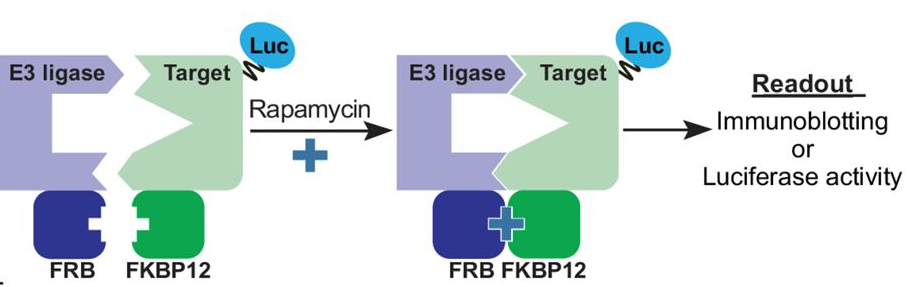
Rapamycin induced proximity assay that allows the expression of E3 ligase target pairs in cells.
Based on the rapamycin-induced proximity assay (RiPA) framework published in eLife (2024), the platform is ideally suited for early-stage SAR campaigns and E3 ligase pair validation, before investing in more complex cellular models.
How it works
E3 ligases are brought into close proximity of the respected target by the addition of Rapamycin. Subsequently, E3 ligase induced target degradation can be measured by luciferase. RiPA is a quantitative and scalable cellular assay that predicts the suitability of E3 ligases for a specific target.
Adapted from Adhikari et al., eLife 2024 (CC BY 4.0)
Deliverables
Degradation %
TBD
TBD
Best E3 ligase–target pairsMedChem-freeTBD
Interested in RiPA?
Request a quote or consultation
Tell us about your target and E3 ligase pair and we will respond within two business days.
The HiBiT assay uses CRISPR/Cas9 knock-in cell lines expressing endogenous target proteins tagged with the 11-amino acid HiBiT peptide. When combined with its complementary partner LgBiT, HiBiT reconstitutes functional NanoLuc luciferase, generating a luminescent signal directly proportional to target protein abundance.
Because HiBiT is introduced at the endogenous locus, proteins are expressed under native promoter control and at physiological levels — eliminating the overexpression artefacts common in reporter cell line approaches.
How it works
Following PROTAC treatment, target protein degradation is read out as a dose- and time-dependent decrease in luminescence. Lysineless HiBiT variants are used where necessary to prevent interference with the ubiquitination machinery. Both real-time kinetic and endpoint formats are supported.
The small tag size (~11 amino acids) minimises steric interference, and the high sensitivity of the NanoBiT system enables detection of low-expressed endogenous proteins without enrichment steps.
NanoBRET (Bioluminescence Resonance Energy Transfer) provides a direct live-cell readout of PROTAC ternary complex formation. The target protein is fused to NanoLuc luciferase (the energy donor) while the E3 ligase of interest is expressed as a HaloTag fusion labelled with a fluorescent acceptor ligand.
When a PROTAC successfully bridges the two proteins, proximity-dependent energy transfer generates a quantitative BRET signal. This directly reports productive E3 ligase recruitment and ternary complex stability in a physiologically relevant, live-cell context.
Two assay formats
Target engagement — measures intracellular PROTAC binding to the target protein. Performed in live- and permeabilized-cell mode to resolve cell permeability from intrinsic binding affinity. Yields Relative Binding Affinity (RBA) and Availability Index (AI).
Ternary complex — confirms functional E3 ligase recruitment. Identifies compounds that bind the target but fail to recruit the ligase — a frequent failure mode invisible to degradation assays alone.
Verantwortlich fuer die Datenverarbeitung auf dieser Website ist: E3Clypse GmbH, Kiel, Deutschland. E-Mail: info@e3clypse.com
2. Erhebung und Verarbeitung personenbezogener Daten
Wir erheben personenbezogene Daten nur, soweit dies zur Bereitstellung unserer Dienstleistungen und zur Beantwortung von Anfragen erforderlich ist. Dies umfasst Name, Vorname, E-Mail-Adresse, Organisation, Rolle und projektbezogene Informationen.
3. Rechtsgrundlage
Die Verarbeitung erfolgt auf Grundlage von Art. 6 Abs. 1 lit. b DSGVO sowie Art. 6 Abs. 1 lit. a DSGVO soweit Sie uns diese erteilt haben.
4. Weitergabe von Daten
Eine Weitergabe Ihrer personenbezogenen Daten an Dritte erfolgt nicht ohne Ihre ausdrueckliche schriftliche Einwilligung, es sei denn, wir sind gesetzlich dazu verpflichtet.
5. Speicherdauer
Ihre Daten werden nur so lange gespeichert, wie es fuer den jeweiligen Zweck erforderlich ist oder gesetzliche Aufbewahrungsfristen dies erfordern.
6. Ihre Rechte
Sie haben das Recht auf Auskunft, Berichtigung, Loeschung, Einschraenkung der Verarbeitung, Datenuebertragbarkeit und Widerspruch. Bitte wenden Sie sich hierzu an info@e3clypse.com
7. Beschwerderecht
Sie haben das Recht, sich bei der zustaendigen Datenschutzaufsichtsbehoerde zu beschweren. In Schleswig-Holstein ist dies das Unabhaengige Landeszentrum fuer Datenschutz Schleswig-Holstein (ULD), Kiel.
E3Clypse
Regulatory Compliance
Cell Line Authentication and Containment
All cell lines are sourced from authenticated biorepositories including ATCC, DSMZ and ECACC. Routine STR profiling and mycoplasma screening ensure cell line integrity. In-house cell lines are governed by a Material Transfer Agreement and may be freely used in publications, with co-authorship of the contributing Clypse-Open scientists as a prerequisite. Work with genetically modified cell lines complies with EU Directive 2009/41/EC and the German GenTG and GenTSV.
Animal Studies
Clypse-Open applies the 3Rs principles (Replacement, Reduction, Refinement). All animal studies are conducted in full compliance with:
EU Directive 2010/63/EU on the protection of animals used for scientific purposes
German Animal Welfare Act (Tierschutzgesetz, TierSchG)
All protocols are approved by the competent authority in Schleswig-Holstein prior to commencement.
GLP and Data Integrity
Studies follow Good Laboratory Practice (GLP) principles. All SOPs, calibration records and raw data are archived in a controlled document management system and available for client audit on request.
E3Clypse
Impressum
Angaben gemaess § 5 TMG
E3Clypse GmbH [Strasse und Hausnummer] 24[XXX] Kiel Deutschland
Kontakt
E-Mail: info@e3clypse.com
Handelsregister
Eingetragen im Handelsregister. Registergericht: Amtsgericht Kiel Registernummer: HRB [XXXXX]
Geschaeftsfuehrung
Dr. Anneke Kramm
Umsatzsteuer-ID
Umsatzsteuer-Identifikationsnummer gemaess § 27 a Umsatzsteuergesetz: DE [XXXXXXXXX]
Haftung fuer Inhalte
Als Diensteanbieter sind wir gemaess § 7 Abs. 1 TMG fuer eigene Inhalte auf diesen Seiten nach den allgemeinen Gesetzen verantwortlich. Nach §§ 8 bis 10 TMG sind wir als Diensteanbieter jedoch nicht verpflichtet, uebermittelte oder gespeicherte fremde Informationen zu ueberwachen oder nach Umstaenden zu forschen, die auf eine rechtswidrige Taetigkeit hinweisen.
Haftung fuer Links
Unser Angebot enthaelt Links zu externen Webseiten Dritter, auf deren Inhalte wir keinen Einfluss haben. Deshalb koennen wir fuer diese fremden Inhalte auch keine Gewaehr uebernehmen. Fuer die Inhalte der verlinkten Seiten ist stets der jeweilige Anbieter oder Betreiber der Seiten verantwortlich.